Grid tied vs hybrid vs off grid? Almost every home solar decision in New Zealand comes down to these three system types. Grid tied is the simplest and cheapest and stays connected to the grid and represents the majority of solar panel NZ installs. Hybrid adds a battery for evening use and backup power, and is the fast growing category in recent times. Off grid cuts the cord entirely and suits rural properties with no grid connection. This guide explains how each one works, what it costs, and how to tell which fits your home.
The three home solar systems at a glance
Here is a side by side comparison of grid tied, hybrid and off grid solar so you can quickly see which system fits. Each row is explained in more detail further down the page.
| Feature | Grid-Tied | Hybrid | Off-Grid |
| Connected to the grid | Yes | Yes | No |
| Powers your home by day | Yes | Yes | Yes |
| Powers your home at night | From the grid | From battery, then grid | From battery (and back-up generator if needed) |
| Backup during outages | No | Yes (essential circuits) | N/A (you are the grid) |
| Sells excess to the grid | Yes | Yes | No |
| Battery required | No | Yes | Yes (larger) |
| Typical upfront cost | Lowest | Mid | Highest |
| Typical payback | 6 to 9 years | 8 to 12 years | Case by case |
| Best for | Urban homes wanting the fastest payback | Most NZ homes wanting flexibility and outage backup | Rural or remote properties with no grid connection |
Anatomy of a solar system
Every residential solar system is built from the same core components. Once you know what each one does, it becomes much easier to picture how the three system types differ.

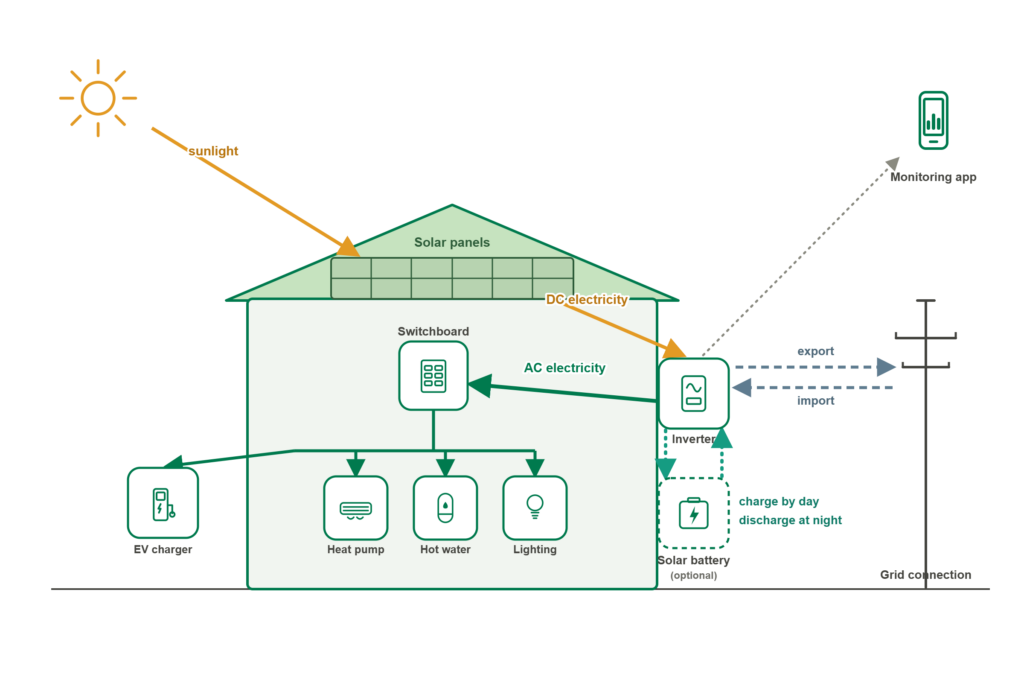
Solar panels. Capture sunlight and convert it into DC electricity. Most NZ homes need between 10 and 20 panels.
Inverter. The control centre. It converts DC from the panels into the AC your home uses, and decides where each kWh goes. The type of inverter you choose and whether you have a battery determines whether your system is grid-tied or hybrid.
Solar battery (optional). Stores power you generate during the day for use at night or during a power outage. It is required for hybrid and off-grid systems. Standard grid-tied systems do not have a battery, but one is easy to add later if your inverter is hybrid-ready and/or select an Atmoce battery.
Switchboard. Distributes power to your circuits, and with the right battery setup, isolates essential circuits during a grid outage so they stay running.
Grid connection. How most NZ homes import power when their solar is not covering demand, and how they export surplus back to their retailer for a buy-back credit.
Monitoring app. Watch your system generate, store and export power in real time from your phone. All major brands include an app.
Grid-tied solar: the starter system
Grid-tied solar is the simplest and lowest-cost way to go solar, and it stays connected to the grid. Your panels generate power during the day. Your inverter sends what you need to the home and exports the rest to the grid for a buy-back credit from your retailer. At night, or when your panels are not producing electricity, you draw from the grid as normal.

Grid-tied solar is best for
- Urban or suburban homes connected to the grid
- Households who use a lot of power during the day (at home during the day, daytime appliance use)
- People wanting the shortest possible payback period
- Homeowners not yet sure they need outage backup
Pros
- Lowest upfront cost of the three options
- Shortest payback (typically 6 to 9 years in NZ)
- Simple to install and maintain
- Future-upgradeable: add a battery later by replacing the inverter, or use a retrofit battery like Atmoce
Cons
- Shuts down during a grid outage (this is a safety requirement)
- You still pay daily fixed line charges to your retailer
- Surplus generation is sold cheap and bought back expensive
Typical cost: $8,000 to $15,000 installed. Typical payback: 6 to 9 years.
Hybrid solar: the most popular choice for NZ homes
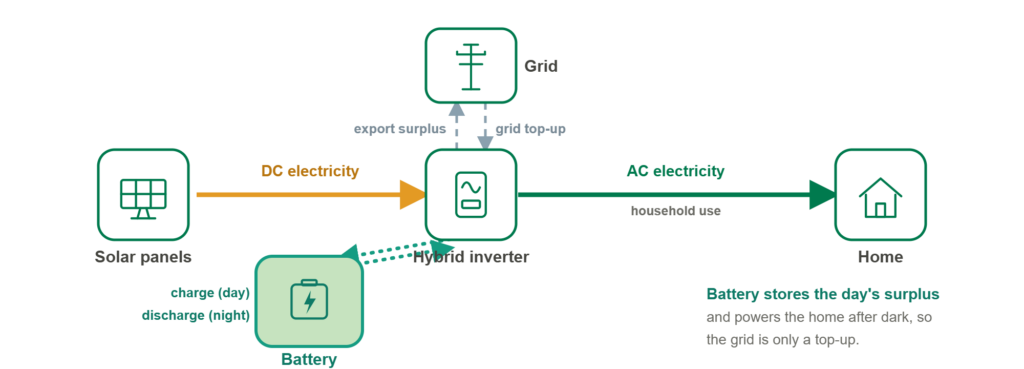
Hybrid solar is grid-tied solar plus a battery, and it is the fastest growing choice for New Zealand homes today. Your panels generate power during the day. Your hybrid inverter sends what you need to the home, charges your battery with the surplus, and if there is still more left over, exports to the grid. At night, you run on the battery first, then draw from the grid only when the battery runs low. If the grid drops out, your battery automatically powers your essential circuits.
Hybrid solar is best for
- Most New Zealand homes connected to the grid
- Households who use more power in the evening than during the day
- People in storm-prone or outage-prone areas
- Homeowners who want to maximise their use of their own solar
Pros
- Self-consumption typically rises from around 30% (grid-tied) to 70 to 90%
- Backup power during grid outages on essential circuits
- Greater protection from rising retail electricity prices
- Can still sell excess generation to the grid
Cons
- Higher upfront cost than grid-tied
- Battery typically lasts 10 to 15 years, so plan for a future replacement
- Slightly longer payback (typically 8 to 12 years)
- You still pay daily fixed line charges to your retailer
Typical cost: $18,000 to $30,000 installed. Typical payback: 8 to 12 years
Off-grid solar: total energy independence
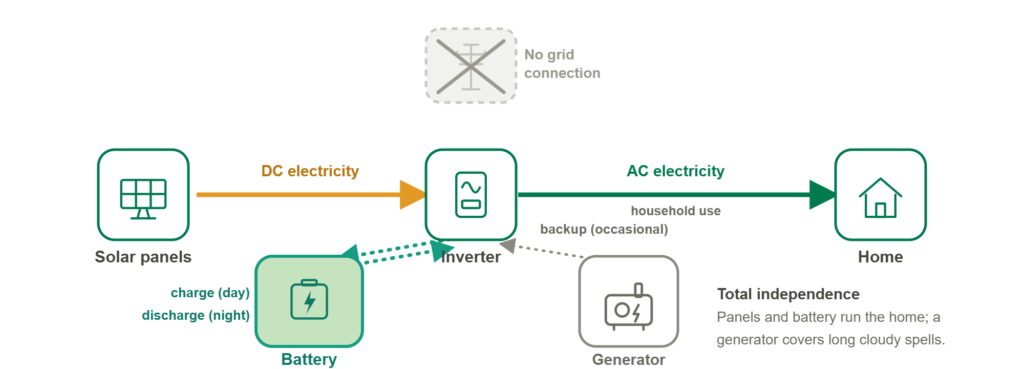
Off-grid solar disconnects from the grid entirely and runs your home on solar and battery alone, and it suits homes with no grid connection. Your panels generate power during the day. Your inverter powers the home and charges a larger battery with the surplus. At night and on cloudy stretches, you run on the battery. A small backup generator (typically diesel or LPG) is included for the few days a year when extended cloud or unusually high demand overwhelms what the system can provide on its own.
Off-grid solar is best for
- Rural or remote properties with no grid connection
- Properties where extending the grid would cost more than going off-grid
- Lifestyle blocks, baches and farm buildings
- Homeowners who want total independence from electricity retailers
Pros
- Total energy independence: no retailer, no line charges, no grid outages
- Often cheaper than running new power lines to a remote site
- Long-term cost certainty (no exposure to retail price increases)
Cons
- Highest upfront cost of the three options
- Backup generator needed for prolonged poor-generation periods
- System must be over-sized to cover worst-case conditions
- No buy-back revenue (you cannot export to a grid you are not connected to)
Typical cost: $30,000 to $80,000+ installed. Best value when the alternative is paying for a new grid connection
How to choose the right solar system Grid-tied vs Hybrid vs off-grid: six questions
These six questions will get you most of the way to the right answer. Take a few minutes with them before your free consultation. The clearer you are on what you want, the better the recommendation you will get.
1. Are you connected to the grid?
If yes, your real choice is between grid-tied and hybrid. If no, or if a new grid connection would cost more than going off-grid, then off-grid is on the table.
2. When do you use most of your power?
If most of your usage is during the day (someone home, heat pumps running, EV charging in the afternoon), grid-tied may give you the fastest payback. If most of your usage is in the evening, a hybrid system will save you significantly more over time.
3. How important is backup power during outages?
If you have experienced repeated outages, work from home, run a home business, or have medical equipment that needs reliable power, a hybrid system with battery backup is worth the extra upfront cost.
4. What is your budget?
Grid-tied is the lowest upfront cost. Hybrid is a step up. Off-grid is the highest. But all three are commonly financed, and many customers find the monthly repayment lower than their previous power bill, especially when paired with a free in-home energy consultation to right-size the system.
5. Do you plan to add a battery, EV charger or heat pump later?
If yes, ask your installer to design the system to be upgradeable from day one. The right inverter and switchboard at the start saves significant rework later. A grid-tied install on a hybrid-ready inverter is the most flexible starting point.
6. How long do you plan to stay in this home?
Solar adds long-term value either way, but the longer you stay, the more years of free generation you enjoy after payback. If you are planning to sell within a few years, focus on resale appeal and fast payback rather than total system size.
Still not sure? That is exactly what a free in-home consultation is for. The right system depends on the specifics of your home, your power use, and your priorities. We will come to you, look at all of it, and tell you what we would recommend Book your free solar consultation
What happens next: the Future Energy process
If you would like a recommendation tailored to your home, the next step is a free in-home consultation with one of our energy consultants. Here is what happens from here.
1. Free consult
One of our team comes to your home, looks at your roof, switchboard and current power bills, and asks how you actually use power day to day. It takes about an hour. We can also meet over video call if that suits you better.
2. Custom design
We design a system specific to your home: the right panel count, the right inverter, the right battery (if any), and the right brand for your situation. Independent advice, not a fixed package.
3. Same-day quote
You leave the consultation with a detailed, itemised quote in writing, plus finance options if you want them. No pressure to sign on the day.
4. Installation
Our project team manages your install from start to finish, including all consents and grid sign-off. Most residential installations are completed within four to eight weeks of a signed quote.
5. Aftercare
Once you are switched on, we stay your single point of contact for the life of the system: workmanship warranty, monitoring app setup, and one number to call if you have questions, ever.
Future Energy designs and project-manages residential solar systems across six regions of New Zealand. We work with the world’s leading panel, inverter and battery brands, and we recommend the right one for your home. Wherever you are, our team manages the project from first conversation through the lifetime of your system.
14.5 MW solar delivered • 290+ five-star reviews • 6 regions served nationwide
Frequently asked questions
What is the difference between grid-tied, hybrid and off-grid solar?
Grid-tied solar stays connected to the grid and has no battery, so it is the cheapest but shuts down in a power cut. Hybrid solar adds a battery, so it powers your home in the evening and keeps essential circuits running during outages. Off-grid solar has no grid connection at all and runs entirely on solar, a larger battery and a backup generator.
Which solar system is most popular in New Zealand?
Grid-tied rsystems without a battery is still the most commonly installed home solar setup.
Hybrid solar is the fastest growing choice for New Zealand homes today. It lets you use more of the power you generate (self-consumption typically rises from around 30% to between 70 and 90%), gives you backup power during outages, and protects you from rising retail electricity prices.
How much does a home solar system cost in NZ?
A grid-tied system typically costs $8,000 to $15,000 installed, a hybrid system with a battery typically costs $18,000 to $30,000, and an off-grid system typically costs $30,000 to $80,000 or more. The exact cost depends on your power use, roof and the brands you choose.
What is the payback period on solar in New Zealand?
Grid-tied solar typically pays back in 6 to 9 years and hybrid solar in 8 to 12 years. Off-grid payback is assessed case by case, and is often strongest when the alternative is paying for a new grid connection.
Can I add a battery to my solar system later?
Yes. If your system is installed on a hybrid-ready inverter, you can usually add a battery later without replacing the whole system. If you have a standard grid-tied inverter, you can either replace the inverter or add a retrofit battery. Planning for this from day one saves rework.
Does solar work during a power cut?
Only if you have a battery. Standard grid-tied systems shut down during a grid outage for safety reasons. A hybrid system with a battery automatically keeps your essential circuits running, and an off-grid system is unaffected because it is not connected to the grid.
How many solar panels does a NZ home need?
Most New Zealand homes need between 10 and 20 panels. The right number depends on how much power you use, your roof space and orientation, and whether you are adding a battery, EV charger or heat pump.
Is off-grid solar worth it?
Off-grid solar is worth it when your property has no grid connection, or when extending the grid to your site would cost more than an off-grid system. It provides complete independence from electricity retailers, but it has the highest upfront cost and requires a backup generator during prolonged periods of low generation.
Ready when you are
The right system depends on the specifics of your home, your power use and your priorities. Book a free in-home solar consultation and we will look at all of it and tell you what we would recommend. Same-day quote, no obligation.
Book a Free Consult or call 0800 338 363
Sources: this guide draws on Future Energy’s own installation experience plus Rewiring Aotearoa, EECA, MBIE and SEANZ