| NZ$1.96M Total project investment (~FJ$2.65M) | 50% Energy cost saving projected for year one | 2 to 3 years Payback from operational savings alone | NZ$630K Annual energy savings (before tax incentives) |
A Future Energy off grid commercial solar and battery case study. NZ$1.96M project across three remote Pacific islands. 50% energy cost saving projected for year one. Payback in 2 to 3 years from operational savings alone.
Executive summary
Yasawa Island Resorts (Paradise Cove, Blue Lagoon, Octopus) operated entirely on diesel generated electricity, with bottled gas for cooking and hot water, until late 2025. New Zealand sustainable energy company Future Energy delivered an off grid commercial solar and battery system: 760 kW of solar, 1.6 MW of SolaX AELIO modular battery storage, and trained eight Fijian electricians to run and maintain it. When the global oil crisis hit and Fiji’s diesel prices surged 80%, the resorts were already insulated. 50% energy cost savings projected for year one. 2 to 3 year pre tax payback on Nick Wood’s own figures. The case study below sets out what worked, what we learned, and what it proves for off grid commercial sites in New Zealand and the Pacific.
The problem: high energy costs, no usage visibility, poor reliability
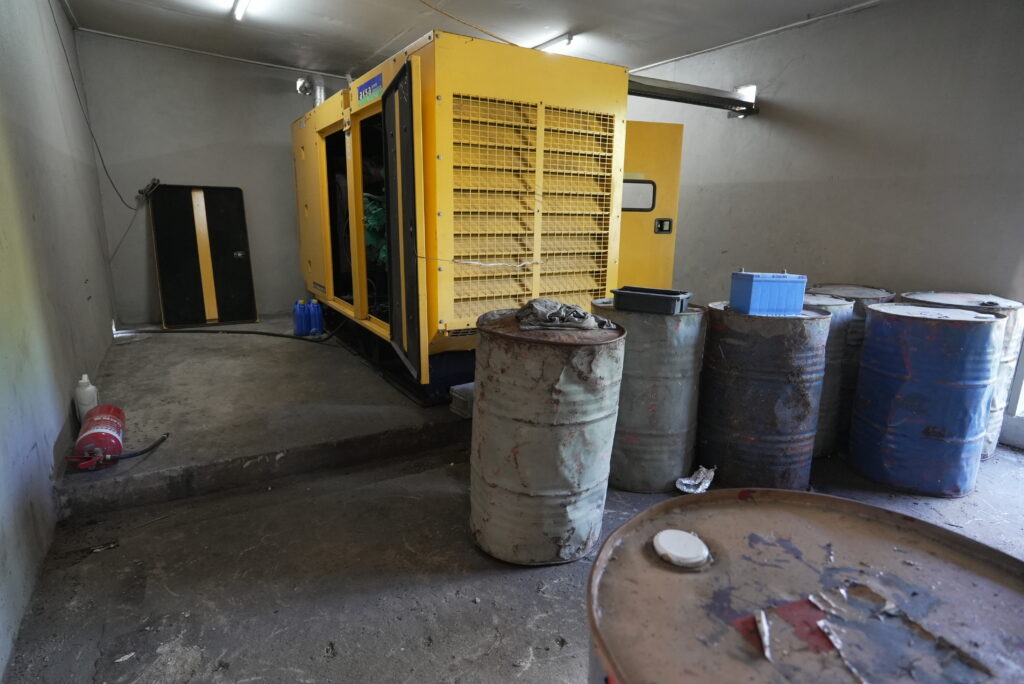
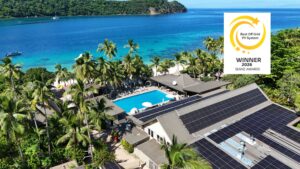
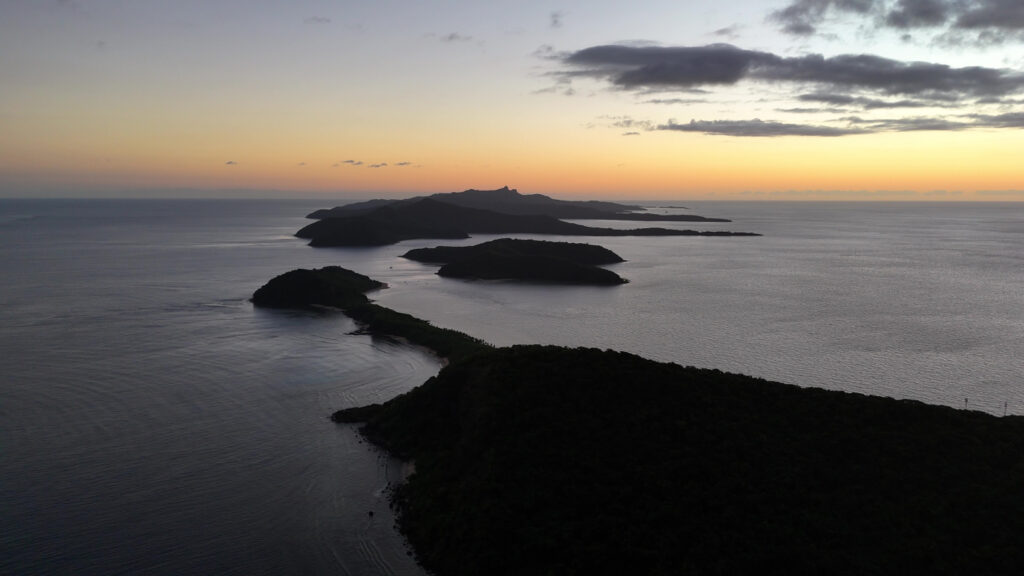
Paradise Cove, Blue Lagoon and Octopus sit on three of Fiji’s Yasawa Islands. No national grid reaches them. Until 2025, every kilowatt of electricity the resorts consumed came from diesel shipped from the mainland by barge, then rolled across the beaches in 200 litre barrels to be fed into on site generators. Bottled gas, also shipped from the mainland, powered cooking and hot water.
Three problems compounded each other.
1. High energy costs
Operating costs for diesel fired generation were already significant before the global oil crisis. In early 2026, the closure of the Strait of Hormuz triggered an 80% surge in Fiji’s diesel prices. Without the transition already in place, Yasawa’s operating cost exposure would have been substantial. The solar and battery system installed by Future Energy insulated the resorts from the shock.
“If you look at the fuel we were using at Paradise and the 80% surge in diesel prices, the increase in our operating costs would have been substantial. Instead, we’re at similar levels to what we were at before we energised the system”
– Nick Wood, Owner, Yasawa Island Resorts (co-founder, iHug)
The economic case for moving away from diesel had shifted. Solar plus battery was no longer a sustainability conversation. It had become a balance sheet decision.
2. No usage visibility
Before the solar and battery system, Yasawa had no real time view of where energy was being consumed across the three resorts. Generators ran, fuel was burned, and decisions about new restaurants, additional guest rooms or load growth were made without underlying load data. Capital decisions were guesswork.
3. Poor reliability and team stress
Diesel generators routinely overheated and shut down mid service on humid Pacific evenings when air conditioning peaked, leaving dining guests in darkness. Beyond the guest experience, the load fell on the resort engineering teams, who were on constant standby for failures without the visibility to predict or prevent them.
The decision: a 2-to-3-year payback, funded from cash flow
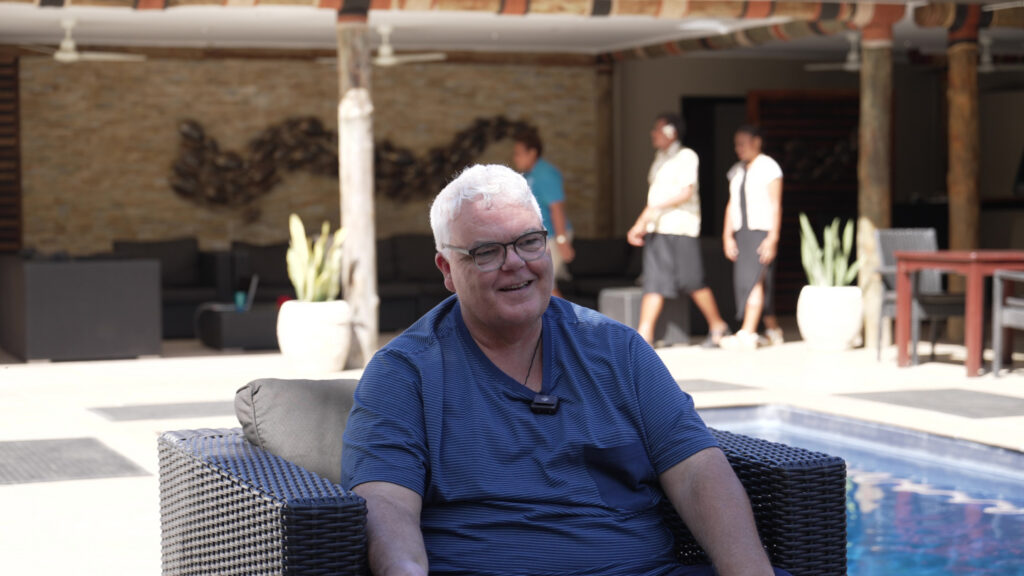
Nick Wood (a New Zealand business owner who co founded the NZ internet service provider iHug) approached Future Energy in 2024 about an off grid commercial solar and battery transition for the three resorts. Future Energy and Nick spent the better part of two years on the design, planning and procurement.
The case was built on a hard nosed economic argument: a 2 to 3 year payback before tax incentives, funded entirely from operational cash flow, with savings flowing from day one. The modularity of the SolaX AELIO battery platform was the unlock: resorts could install batteries in stages, scaling capacity as cash flow allowed, rather than writing the full cheque up front for a single large container bank.
“You can get your money back in probably two to three years.”
– Nick Wood, on the project payback
With the modular path agreed, Future Energy committed to a fully integrated build: design, supply, installation, commissioning, training, and ongoing system monitoring across all three resorts.
The build: 760 kW solar, 1.6 MW battery, three islands
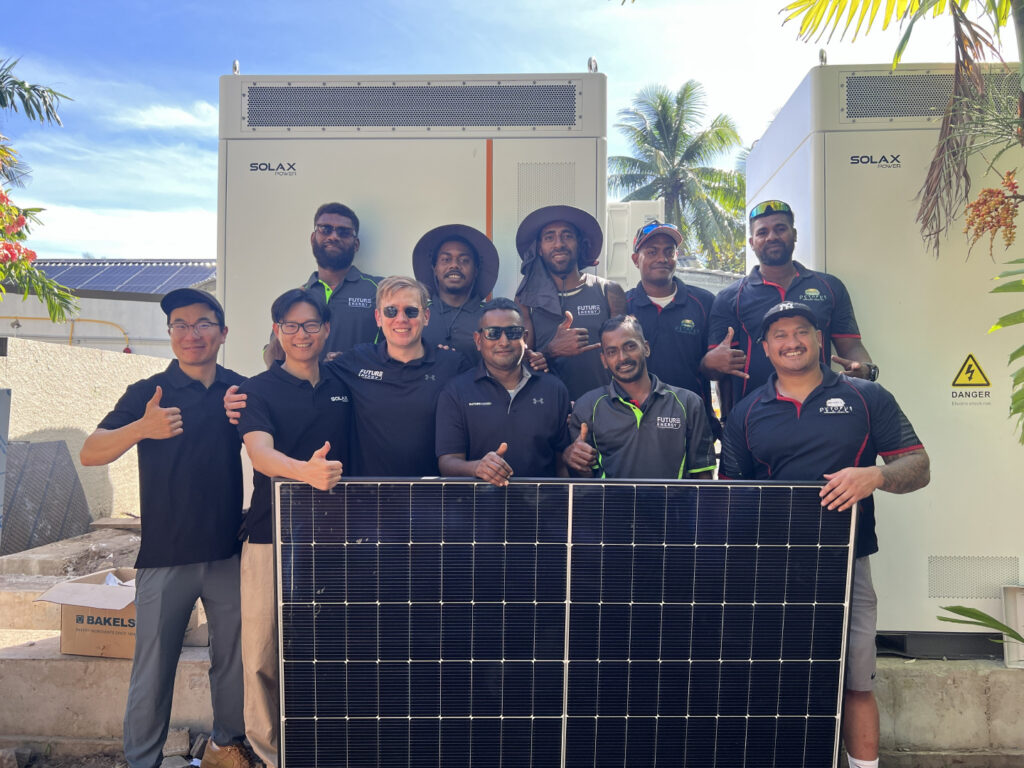
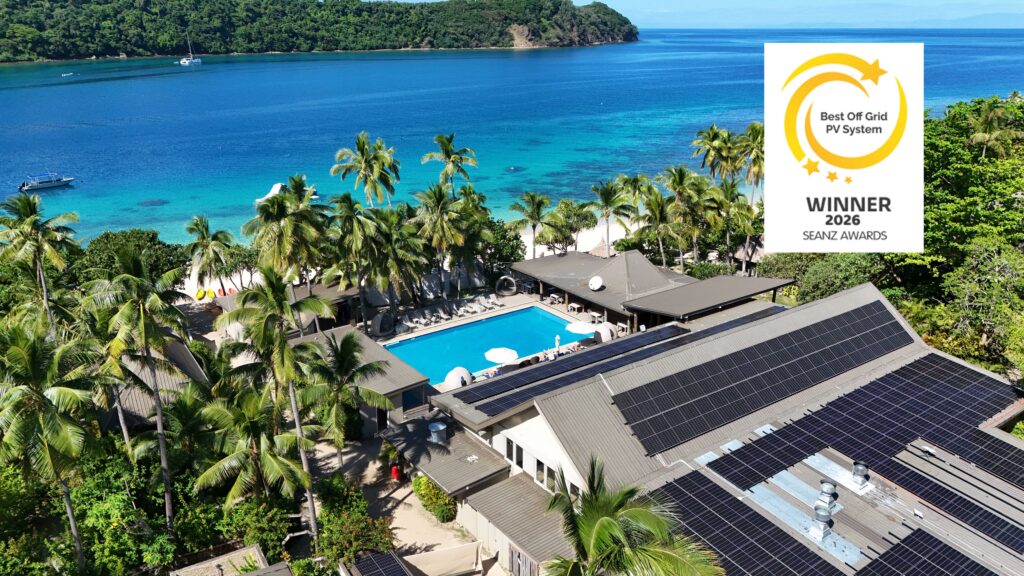
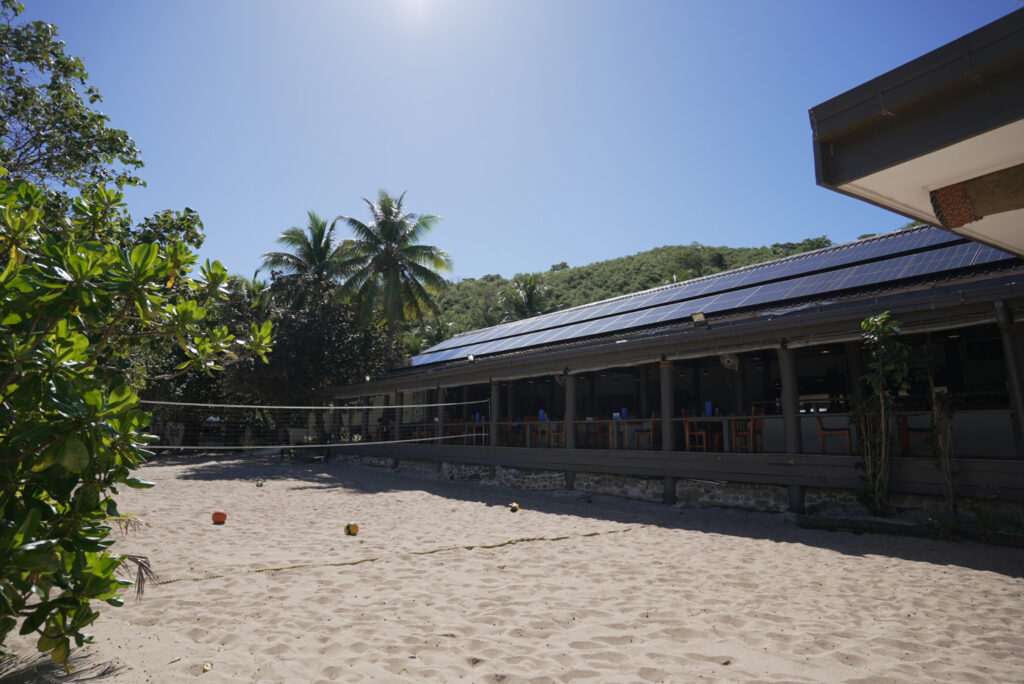
Future Energy shipped five 40 foot containers from New Zealand to Fiji. Paradise Cove has a barge and a jetty, which made delivery more manageable. The other two resorts required additional handling: panels and batteries were carried by hand across beaches in places, by the resort teams and the Future Energy crew.
The installed system across the three resorts:
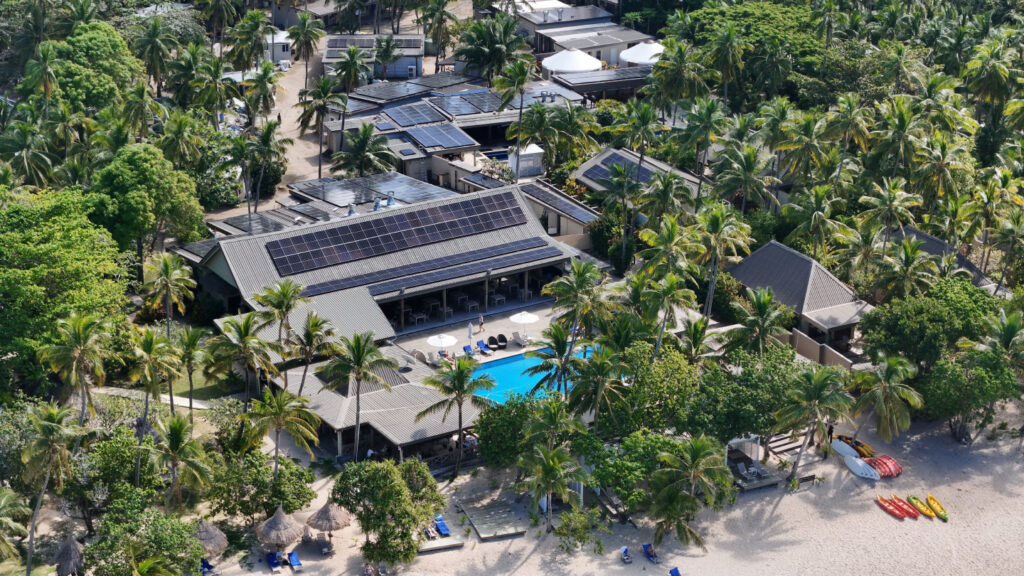
- 760 kW of solar generation capacity
- 1,700+ solar panels deployed
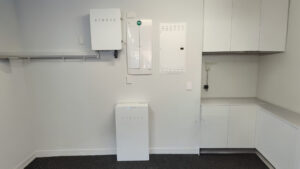
- 1.6 MW of battery storage, eight SolaX AELIO battery cabinets, modular design, one of the largest commercial AELIO deployments in the Pacific
- Real time monitoring and control across all three sites (see the next section)
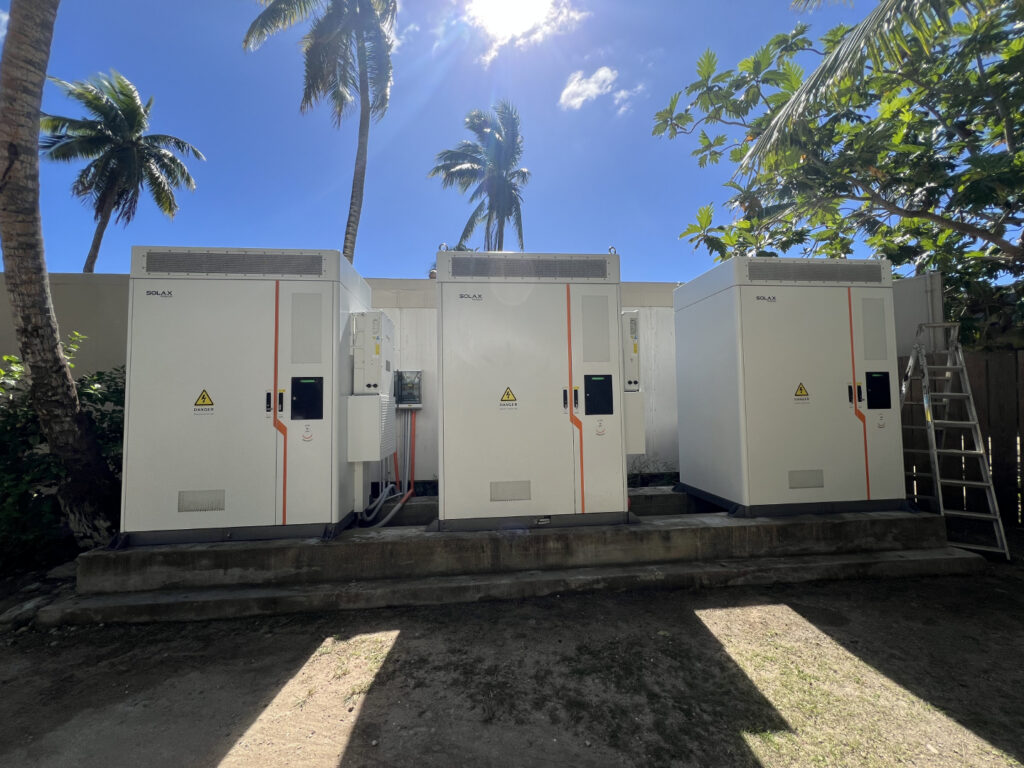
The first island (Paradise Cove) was commissioned in September 2025. The third (Octopus) in June 2026. SolaX Power Australia, a wholly owned subsidiary of global energy storage leader SolaX, supplied the AELIO battery platform.
“A remote Fijian island was a demanding environment: no grid, salt air and extreme heat. AELIO performed across all three resorts and the savings speak for themselves. Our partnership with Future Energy shows what’s possible in remote, off grid conditions. This solution is available to any operator across the Pacific still relying on expensive imported diesel.”
– Joey Zhang, General Manager, SolaX Power Australia
Local capability: eight Fijian electricians who manage the system
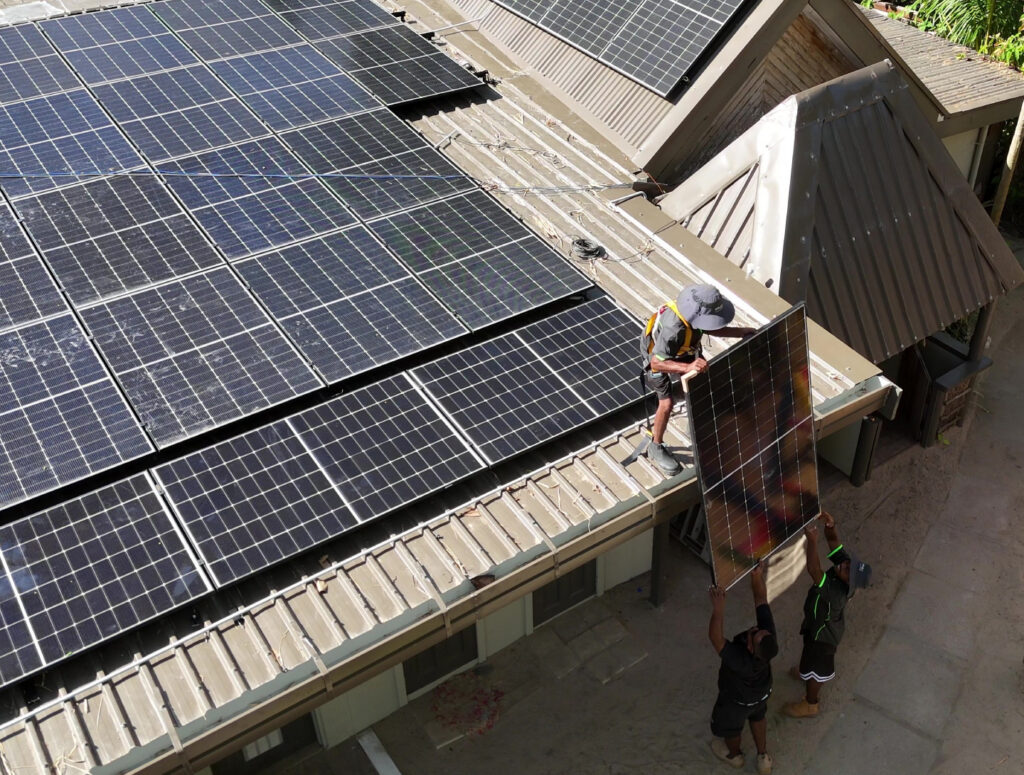
Future Energy actively monitors the system remotely (see the monitoring section below). But flying technicians from New Zealand for every fault was never going to be commercially viable for three remote Pacific resorts.
So Future Energy trained eight Fijian electricians end to end. They began the project with no solar experience. They now run and maintain the entire 1.6 MW solar and battery system across all three resorts, with Future Energy and SolaX support when needed.
“Now we are the experts. Before this project began, we had no experience, and now we can fully manage the solar system and install more panels. Each resort has their own electrician who were all trained here. So they are running the show now.”
– Para, Lead Engineer, Yasawa Island Resorts
Monitoring: real time data that unlocked growth
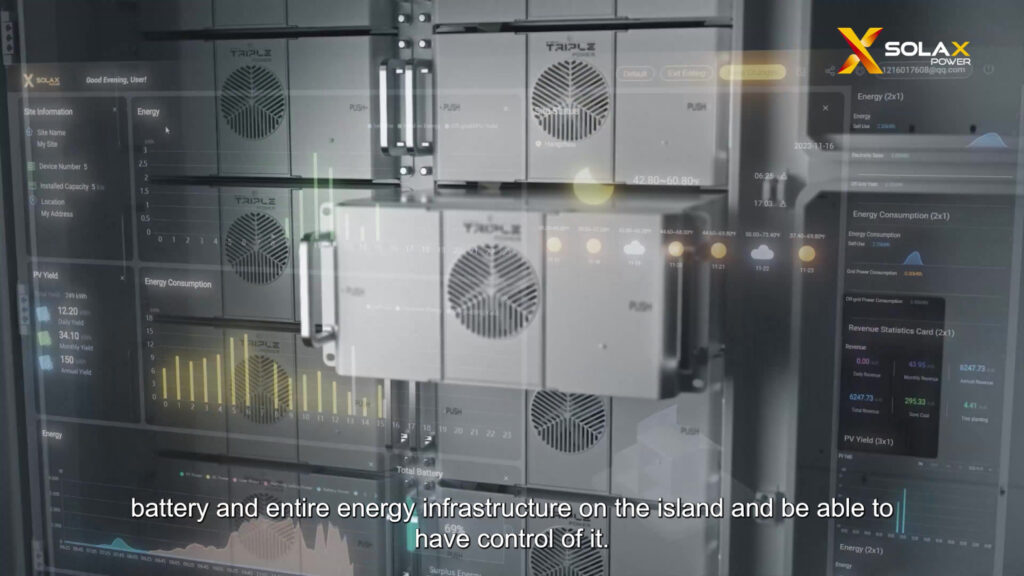
Capability transfer to the Fijian team handles fault response and routine maintenance. The bigger operational shift came from the monitoring platform itself.
The SolaX battery management system delivers real time data on generation, consumption and battery state across all three resorts. Future Energy monitors performance remotely and intervenes if alerts flag a system issue. The resort operators have the same view, but the value to them is different: for the first time, they can see exactly where energy is being used, when peaks happen, and how much headroom they have before they need additional capacity.
That visibility is enabling growth. New restaurants. Additional guest rooms. Even a transition from gas hot water to electric. Decisions that previously had to be modelled on diesel fired guesswork are now built on actual load data.
“We opened two more restaurants because the solar and battery system gave us more useable energy and greater visibility about energy consumption.”
– Para, Lead Engineer, Yasawa Island Resorts
Real time monitoring is delivering more than fault response. It’s a planning tool for further commercial development.
The outcome: the numbers that matter
| Metric | Projected for year one (full year 2026) |
|---|---|
| Energy cost saving | 50% |
| Annual energy saving (NZD) | ~NZ$630,000 (before tax incentives) |
| Pre tax payback (Nick Wood’s own figure) | 2 to 3 years |
| Post tax payback (Fiji 100% capital write-off applied) | 18 to 27 months |
| CO2 avoided (annual, all three resorts) | 464.68 tonnes (estimated; savings dependent on sunlight conditions) |
Across the first six months of operation, the system delivered 35% energy cost saving while the build was still being completed (Nick Wood’s words: “we definitely made a physical dollar savings of 35%… and that was ramping”). With the full system commissioned, 50% is projected for full-year 2026. The longer term Yasawa target is 70-75% by end of 2027, with further battery and panel capacity to be added. The system is also expected to avoid approximately 464 tonnes of CO2 per year (estimated, dependent on sunlight conditions).
Beyond the headline numbers, the operational benefits are immediate. Solar now reliably powers the water desalination plants that produce drinking water for approximately 200 live in staff and tens of thousands of guests every year. Diesel generators are now run at much lower loads than they used to. Mid service shutdowns that previously left guests in the dark are becoming a thing of the past.
The Fijian tax case: how the maths gets sharper
Fiji’s tax regime makes the commercial case for off grid solar and battery sharper than the headline payback figure suggests. Three concessions matter for any Fiji based commercial operator looking at solar and battery.
| Concession | What it means for the project |
|---|---|
| 100% capital expenditure write off | Eligible renewable energy plant and machinery can be written off in full in the year of investment, against Fiji’s 25% corporate tax rate. Effective net CAPEX = investment x 0.75. |
| Duty free importation | Solar panels and battery systems are imported duty free under the same regulation. |
| Window | Both concessions are currently available until 31 December 2028. |
Applied to the Yasawa Islands Solar Project, the maths is straightforward. Investment of approximately FJ$2,650,000 (~NZ$1.96M). With the 100% write off applied at the 25% corporate tax rate, effective net CAPEX = FJ$1,987,500 (~NZ$1.47M). The annual energy cost saving is unchanged, so post tax payback compresses from Nick’s 2 to 3 years to 18 to 27 months.
For a Fiji based commercial operator running on diesel, hospitality, mining support, tourism, manufacturing, off grid telecommunications, those incentives can shift a marginal project into a clearly compelling one. Context: Fiji’s fuel import bill is currently around three times the country’s healthcare budget.
Source: Fiji Revenue and Customs Service (FRCS); Fiji Income Tax Act, Exempt Income Regulations 2016 Part 9 (Economic Development Exemptions); KPMG summary of the Fiji 2025-26 National Budget. Verified with Nick Wood, 13 May 2026.
What’s next: solar enabling further electrification
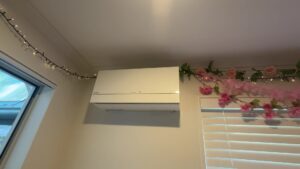
The Stage 1 system has surplus daytime generation capacity. The resorts are using it to switch from bottled gas hot water to hot water heat pump systems across all three properties this year. Once complete, the heat pump transition is expected to save a further FJ$95,000 to FJ$110,000 (~NZ$70,000 to NZ$80,000) per year in gas costs.
Stage 2 of the Yasawa project, planned for delivery by end of 2027, will add further battery cabinets and panel capacity to lift the energy cost saving from 50% to 70-75%. Beyond that, Nick Wood’s longer term ambition is for the resorts to reach approximately 95% combined gas and diesel reduction by the end of 2028.
What it proves for the Pacific – and for New Zealand
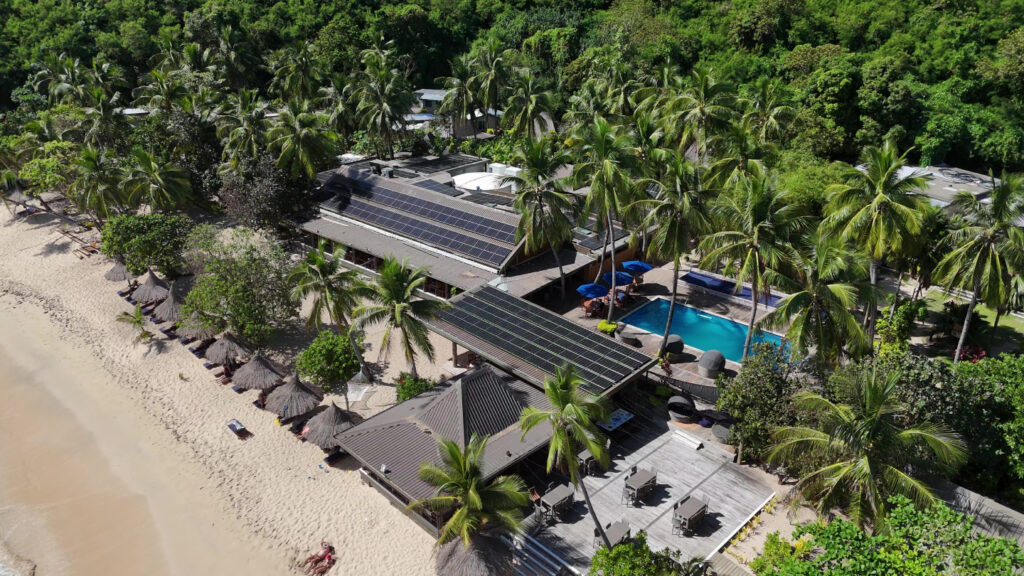
The Yasawa Islands Solar Project delivers commercial fundamentals in the most demanding off grid conditions: no grid, no local supply chain at the install sites, cyclone exposure, two metres of annual rainfall, heavy salt air, variable guest loads.
For other Fiji based commercial operators, the case is direct. Same conditions. Same diesel exposure. Same tax incentives until 31 December 2028. The Yasawa case study provides the proof point.
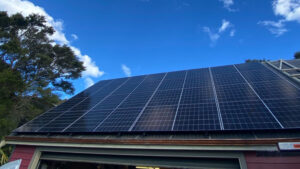
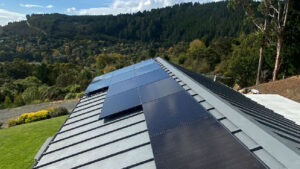
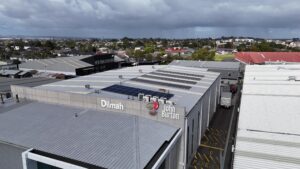
For New Zealand commercial operators the headline figures don’t translate one for one (Fiji’s diesel only baseline and tax write off don’t apply in NZ), but the principle does.
NZ businesses face rising commercial electricity costs, peak demand charges, and a lack of energy security, with some manufacturing plants already closing. These factors, assisted by the IRD Investment Boost (a 20% deduction in year one on eligible solar and battery plant, per IRD policy 2026), make the economic case for solar in New Zealand now very strong, with paybacks regularly occurring by year four.
“If we can do it here, we can do it anywhere. Remote lodges, rural hospitals, marae, data centres, the barriers to solar are lower than most businesses think. And right now, reducing reliance on diesel has real benefits, not just for the environment, but for the bottom line.“
– Alastair Mortensen, Director, Future Energy
Frequently Asked Questions
What did the Yasawa Islands Solar Project cost?
Approximately NZ$1.96 million (FJ$2.65 million) across the three resorts. The project was funded entirely from operational cash flow. Pre tax payback is 2 to 3 years from operational savings alone, on Nick Wood’s own figures. Applying Fiji’s 100% capital write-off for renewable energy (available until 31 December 2028) brings the post tax payback to 18 to 27 months.
Does my New Zealand business need solar AND battery, or is solar alone enough?
For the majority of New Zealand commercial sites, solar panels on their own are enough to drive significant savings. Battery storage adds value where you need guaranteed energy supply through grid outages. And for businesses and communities without reliable grid access, particularly those heavily dependent on diesel generators, solar and batteries together can make a powerful difference. The Yasawa Islands project in this case study is the worked example.
What’s the payback for a typical NZ commercial site?
For grid tied NZ commercial systems, payback is typically 4 to 6 years depending on energy load profile and self consumption. The IRD Investment Boost (a 20% deduction on eligible solar and battery plant in year one) sharpens the case further.
How does Fiji’s solar tax incentive work?
Fiji currently offers a 100% capital-expenditure write off for renewable energy plant and machinery, and duty free importation of solar panels and battery systems. Both are available until 31 December 2028. Applied at Fiji’s 25% corporate tax rate, the write off reduces effective net CAPEX by one quarter and compresses payback proportionally. The Yasawa project’s 18 to 27 month post tax payback is the worked example. Source: FRCS; Fiji Income Tax Act Exempt Income Regulations 2016 Part 9; KPMG summary of Fiji 2025-26 National Budget.
How long does a commercial solar and battery deployment take?
For most New Zealand commercial sites, sign off to switched on is typically 3 to 6 months depending on consenting and equipment lead times. Off-grid Pacific deployments like Yasawa take longer because of shipping logistics and remote install conditions. Yasawa was a multi year programme delivered in phases, with the first island commissioned in September 2025 and the third in June 2026.
What is the SolaX AELIO platform and why was it chosen?
AELIO is a modular commercial battery platform developed by SolaX Power Australia (a wholly owned subsidiary of global energy storage leader SolaX). For the Yasawa project, modularity was the commercial unlock: the resorts could start with what their current load required and add batteries in stages as cash flow allowed. Future Energy is a SolaX Platinum installer.
How can my business find out if commercial solar and battery makes sense for our site?
Future Energy offers a free commercial energy audit, valued at $795. The audit reviews your current energy use, identifies the right scale of solar and battery for your site, models payback and operating savings, and provides a no obligation proposal. Get in touch via the form below or email commercial@future-energy.co.nz.
About Future Energy
Future Energy is a specialist in sustainable energy systems for homes and businesses across Aotearoa New Zealand and the Pacific. The company designs and installs solar PV, battery storage, EV and fleet charging, heat pumps, hot water systems and ventilation, with ongoing service and support. Future Energy delivers projects from residential rooftops to large scale commercial and off grid systems, including remote and island deployments. A SEANZ member and SolaX Platinum installer.
About SolaX Power Australia
SolaX Power Australia empowers Australians to take control of their energy through innovative solar and battery storage solutions. With more than a decade in the Australian and Pacific Region market, SolaX has deployed systems across homes, businesses and commercial installations, including complex, remote and off-grid projects. Visit solaxpower.com.au.
Get a free commercial energy audit. Valued at $795.
If you operate a remote facility, rural site, hospitality operation, marae, iwi-led development, healthcare facility or any commercial property facing high or rising energy costs, we will model what solar would do for your business. No obligation. Takes about an hour.
Future Energy NZ · 0800 338 363 · future-energy.co.nz · commercial@future-energy.co.nz