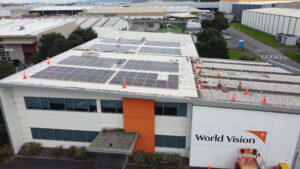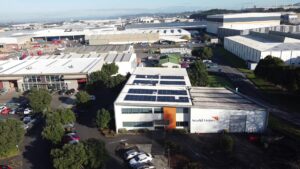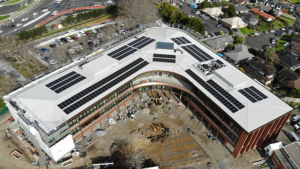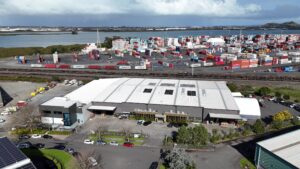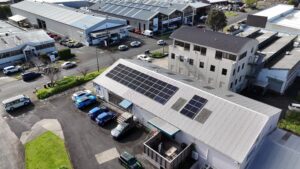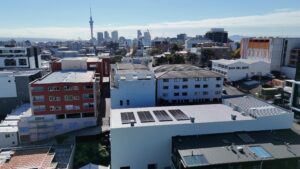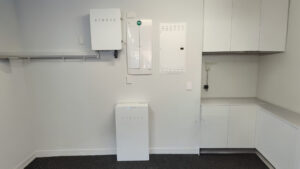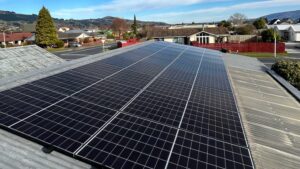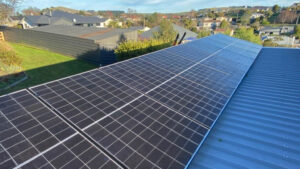
This commercial solar Penrose case study covers the rooftop system Future Energy designed and installed at World Vision New Zealand’s head office. The 110 LONGi panels and three-phase Sungrow inverter offset a significant share of the building’s daytime electricity use, freeing up operating budget for the causes World Vision supports.
Empowering Purpose with Solar at World Vision NZ
Future Energy is proud to support World Vision New Zealand in their mission to build a better, more sustainable future – this time, starting with their own footprint.
At their head office in Penrose, we designed and installed a solar energy system comprising 110 LONGi solar panels, connected via a high-efficiency three-phase inverter. The system is designed to offset a significant portion of the building’s energy use, helping World Vision reduce operational costs and redirect more resources toward the causes they champion.
What makes this project unique isn’t just the technology – it’s the purpose. By turning to solar, World Vision is leading by example, aligning its workplace infrastructure with its broader commitment to sustainability, global stewardship, and climate action.
This is more than an energy upgrade – it’s a step toward a cleaner future, powered by an organisation that works every day to make the world a better place. We’re honoured to have played a role in that journey.
What commercial solar Penrose businesses should know
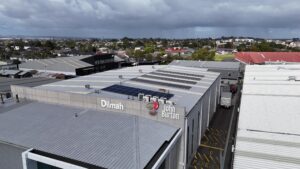
Penrose is one of Auckland’s largest commercial and industrial areas, and its building stock suits solar well. Warehouses, distribution centres and office headquarters tend to have large, flat, unshaded roofs and a weekday operating pattern that lines up with when a solar system generates. That means most of the electricity produced is used on site rather than exported, which is where the financial case is strongest. Most parts of Auckland receive around 2,000 hours of bright sunshine a year according to NIWA, so generation stays reliable across the seasons. For World Vision, the system was sized against the head office’s daytime load rather than simply filling the available roof, so more of what it generates goes straight against the power bill. Commercial solar Penrose businesses install today is also easier to expand later, because inverter capacity and roof space can be planned for a second stage from the outset
Start Your Solar Project with Future Energy
Looking to reduce operational costs and align your organisation with sustainable energy practices? Future Energy designs and installs commercial solar Penrose and wider Auckland businesses rely on, tailored to your site and your load profile.
Frequently Asked Questions
Learn more about how commercial solar installations work for commercial organisations and what to expect from similar projects.
How much energy can a system like this generate?
The output depends on factors such as roof orientation, sunlight exposure, and system size. A setup with 110 panels can offset a large portion of daytime electricity use for commercial buildings.
Why use a three-phase inverter for commercial projects?
Three-phase inverters are suited for larger buildings, as they provide more stable power distribution and efficiently handle higher energy loads.
How long does a commercial solar installation take?
Project timelines vary depending on system size and site conditions. Most installations follow a structured process that includes design, approvals, installation, and commissioning.
Does commercial solar suit a not for profit head office?
Yes, and the case for it is often stronger. Not for profit organisations run the same weekday electricity load as any commercial office, but every dollar saved on power goes back into their programmes. The things to check are the same as for any business: roof age and condition, available unshaded area, and how much of your electricity use falls in daylight hours. World Vision New Zealand’s Penrose head office met all three, which is why a 110 panel array made sense there.
Will solar affect our roof or need building consent?
Mounting systems for commercial rooftops are specified to work with the existing roof structure without compromising weathertightness. A site assessment checks roof age, structural loading and penetration detail before anything is confirmed, and we check consent requirements with the relevant council as part of the design stage. If your roof is near the end of its life, it is usually worth replacing it before the array goes on, rather than paying to remove and refit panels later.
Do you install commercial solar Penrose wide, or only for large sites?
We work across the full range, from small office rooftops to large warehouse arrays. The deciding factor is not building size but how much of your electricity use falls in daylight hours.