| $81,000 Year 1 Savings across all three sites | 93–97% Solar Self-Consumption energy used on-site | 1,217 t CO₂ Carbon Savings over 25 years |
Delivering commercial solar power in a busy CBD environment requires more than technical expertise, it requires flexibility, precision planning, and genuine collaboration with the people who use the buildings every day.
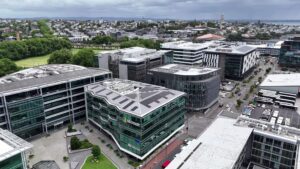
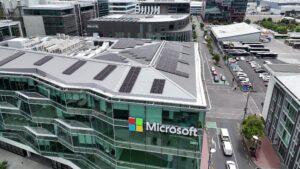
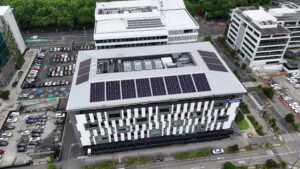
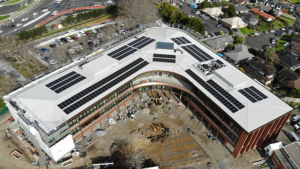
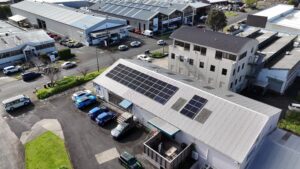
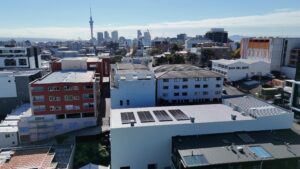
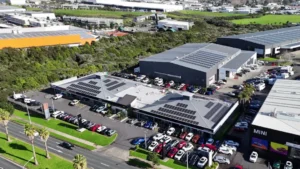
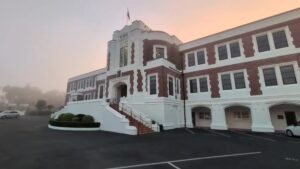
Future Energy partnered closely with Harbour Grounds, both the landlord and building tenants, to design and install a large-scale commercial solar system across three Auckland CBD office sites. The project also included a separate installation for Datacom at 58 Gaunt Street, a high-demand commercial occupier with significant daytime energy needs.
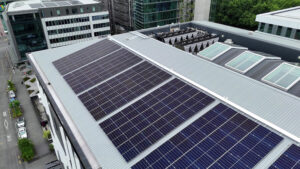
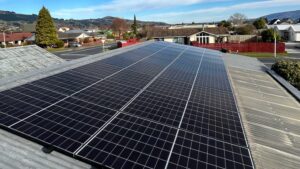
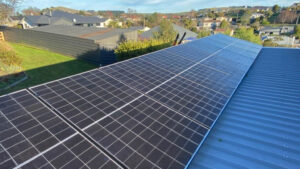
Together, these three buildings now host 650 LONGi solar panels with a combined generation capacity of 323 kW, making this one of the largest commercial solar installations completed in the Auckland CBD.
Site-by-Site Breakdown
Each building was assessed individually, with system size, panel layout, and inverter selection tailored to the roof geometry, energy usage, and network connection requirements of each site.
| Building / Tenant | Solar Array | Panels | Year 1 Savings | Payback | 25-yr NPV |
| Harbour Grounds 30 Gaunt St | 67.7 kW | 144 × LONGi | $16,281 | 5 yrs 5 mths | $268,630 |
| Harbour Grounds 22 Viaduct Harbour Ave | 110.0 kW | 197 × LONGi* | $27,053 | 5 yrs 10 mths | $433,278 |
| Datacom 58 Gaunt St | 145.2 kW | 309 × LONGi | $37,406 | 4 yrs 9 mths | $645,254 |
| COMBINED TOTAL — 650 panels, 323 kW | $80,740 | ~5 yrs avg | $1,347,162 | ||
All three systems use LONGi Hi-MO X6 LR7-54HTH-470M panels, 23% module efficiency with 25-year product and linear power warranties. Inverters are Sungrow commercial-grade units, each with a 10-year warranty and compliance with AS/NZS 4777.2.
The Challenge: Commercial Solar in a Live CBD Environment
Installing commercial solar panels on occupied office buildings in a dense urban environment is a fundamentally different challenge from a standalone industrial or greenfield solar project. At Harbour Grounds, the three buildings operate during standard business hours, with tenants including corporate offices, co-working spaces, and professional services firms who rely on uninterrupted access and minimal disruption.
Key challenges included:
- Coordinating crane lifts and panel delivery on narrow CBD streets with limited access windows
- Scheduling electrical work around building operating hours to avoid disrupting tenants
- Staging the programme across three separate sites simultaneously while maintaining safety and efficiency
- Obtaining network application approvals for Direct Generation (DG) connections across multiple sites
- Adapting the programme to the unique roof geometry and existing mechanical plant at each building
Our Approach: Planning Around the People
Future Energy’s project team worked in close collaboration with Harbour Grounds’ facilities management and tenant representatives throughout the two-month installation programme. Rather than imposing a fixed construction schedule, we designed the programme around the
buildings, completing the most disruptive work outside peak times, including early mornings, late evenings, and weekends.
This approach required:
- Detailed pre-installation planning including SSSP documentation, engineering sign-off, and stakeholder communication
- Flexible crew scheduling to accommodate building access restrictions and minimise noise and disruption during business hours
- Staged site sequencing, completing one roof section before moving to the next, to keep safety zones contained and predictable
- Regular communication with tenants and building management throughout the project
The result was a two-month installation programme that delivered 650 solar panels across three sites without a single significant disruption to building operations.
Results: What the Solar Systems Deliver
The solar systems are now fully operational and performing above initial expectations. With self-consumption rates of 93–97% across the three buildings, the vast majority of solar energy generated is consumed directly on-site rather than exported to the grid, which is where the strongest financial returns are realised, given the difference between retail electricity rates (~20c/kWh) and the feed-in tariff (8c/kWh).
Financial performance
- Combined year 1 savings: $81,000 across all three buildings
- Net cost of solar power generated: $0.04–$0.05/kWh vs ~$0.20/kWh from the grid
- Internal rate of return: 18.1%–22.3% per annum across the three sites
- Combined 25-year net present value: over $1.3 million
- Payback periods ranging from 4 years 9 months to 5 years 10 months
Environmental performance
- Annual CO₂ reduction: 48.5 tonnes across all three buildings
- Total lifetime carbon savings: 1,217 tonnes CO₂-equivalent over 25 years
- Equivalent to removing over 260 fossil fuel cars from the road each year
- Clean energy now supplying approximately 19–20% of each building’s total energy consumption
System performance
- Solar self-consumption rate: 93–97%, minimal export, maximum on-site value
- Module efficiency: 23.0% (LONGi Hi-MO X6)
- Performance ratios: 77–81% across the three sites
- All systems include 25-year panel warranties, 10-year inverter warranties, and 10-year installation warranties
Part of a Broader Sustainable Workplace Strategy
For Harbour Grounds, the solar installation is not a standalone initiative, it forms a core component of a long-term sustainable workplace strategy for their Auckland CBD portfolio. By generating a meaningful portion of their energy on-site from solar power, the buildings can reduce grid dependence, lower operating costs, and demonstrate a tangible commitment to environmental sustainability to their tenants.
For commercial landlords and property owners, solar power offers a compelling proposition: it reduces energy costs (which can be recovered through lower operating expenses or passed through to tenants), improves the environmental credentials of the building, and adds long-term asset value through a technology with a 25+ year operational lifespan.
For tenants like Datacom a major technology company with significant energy consumption and strong ESG commitments, on-site solar generation is a direct contribution to their scope 2 emissions reduction targets.
Why Future Energy for Commercial Solar?
Future Energy is a New Zealand-based commercial solar specialist with deep experience delivering solar power systems for commercial, industrial, and mixed-use buildings across the country. We combine technical expertise with practical project management capability, which is especially important in complex urban environments like the Auckland CBD.
What sets Future Energy apart on commercial solar projects:
- End-to-end project delivery: from initial assessment and system design through to network approvals, installation, commissioning, and ongoing support
- Commercial-grade products: LONGi and Sungrow equipment selected for performance, reliability, and long-term warranty support
- Flexible programme management: we work around your building’s operational requirements, not the other way around
- Full compliance and certification: electrical engineering (SLD), Certificate of Compliance, inspection reports, as-built drawings, and O&M manuals included as standard
- Proven CBD experience : demonstrated ability to deliver large-scale commercial solar in high-density urban environments
Frequently Asked Questions
What is the payback period for commercial solar panels?
For commercial buildings in New Zealand, payback periods for solar power systems typically range from 4–7 years, depending on the size of the system, the building’s energy consumption profile, and the electricity tariff structure. At Harbour Grounds and Datacom, payback periods ranged from 4 years 9 months (58 Gaunt Street) to 5 years 10 months (22 Viaduct Harbour Avenue), with internal rates of return between 18% and 22% per annum.
Can solar panels be installed on occupied commercial buildings?
Yes and Future Energy specialises in exactly this. Our Harbour Grounds project involved installing 650 solar panels across three occupied Auckland CBD office buildings over a two-month period, with all work carefully planned around tenant operating hours. Much of the installation was completed in early mornings, evenings, and on weekends to ensure day-to-day operations were unaffected.
How much energy can commercial solar panels generate?
The amount of energy a commercial solar system generates depends on the system size, panel efficiency, roof orientation, and local solar resource. In Auckland, a well-designed commercial solar system typically produces around 1,200–1,400 kWh per kW of installed capacity per year. The three Future Energy systems at Harbour Grounds and Datacom generate a combined 394,182 kWh per year, equivalent to powering approximately 65 average New Zealand homes.
What solar panels are used in commercial installations?
Future Energy uses LONGi Hi-MO X6 (LR7-54HTH-470M) solar panels for commercial installations, a 470W panel with 23% module efficiency, 25-year product warranty, and 25-year linear power output warranty. These panels are paired with Sungrow commercial-grade inverters (SG50CX and SG110CX models), which offer up to 98.7% conversion efficiency and 10-year warranties.
How does commercial solar reduce carbon emissions?
Commercial solar panels generate electricity from sunlight, displacing electricity that would otherwise be drawn from the national grid. In New Zealand, grid electricity still includes a proportion of fossil fuel generation, so generating solar power on-site reduces the carbon intensity of a building’s energy consumption. The Harbour Grounds and Datacom solar systems collectively avoid 48.5 tonnes of CO₂ per year, equivalent to 1,217 tonnes over 25 years.
What is solar self-consumption and why does it matter for commercial buildings?
Solar self-consumption refers to the percentage of solar energy generated that is consumed directly on-site rather than exported to the grid. For commercial buildings, a high self-consumption rate is financially important because exported solar energy earns a feed-in tariff of around 8c/kWh, while importing grid electricity costs 15–23c/kWh depending on time of day. The Harbour Grounds and Datacom systems achieved 93–97% self-consumption, meaning almost all solar energy generated is used directly in the buildings, maximising financial returns.
Does Future Energy handle the network connection approval for commercial solar?
Yes. Future Energy manages the full network application and approval process as part of our standard commercial solar installation service. This includes the Direct Generation (DG) application to the local network operator and the retail meter application. All three Harbour Grounds / Datacom systems were connected and commissioned with full network compliance, including grid protection boards and electrical engineering sign-off.
What warranties come with a commercial solar installation from Future Energy?
Future Energy commercial solar installations include: 25-year product and linear power output warranties on LONGi solar panels; 10-year warranty on Sungrow inverters; 10-year installation warranty; and Contract Works Insurance during the installation period. All installations also include full electrical certification (Certificate of Compliance, inspection report, as-built drawings, and O&M manuals).
Is commercial solar suitable for CBD office buildings in New Zealand?
Yes – CBD office buildings are well-suited to commercial solar power, provided they have adequate usable roof space and sufficient daytime energy consumption to achieve high self-consumption rates. Office buildings typically consume most of their energy during the same hours that solar panels generate power (business hours, Monday to Friday), which results in strong self-consumption rates and favourable financial returns. Future Energy’s Harbour Grounds project demonstrates that large-scale commercial solar can be successfully delivered even in high-density urban CBD environments.
Get a Commercial Solar Assessment for Your Building
If you manage or own a commercial building in New Zealand and want to understand what solar power could deliver for your energy costs and carbon footprint, Future Energy can help.
We provide no-obligation commercial solar assessments, including detailed system design, energy modelling, and financial analysis tailored to your building’s specific usage profile and electricity tariff.
- Phone: 0800 338 363
- Contact Us
Future Energy: specialists in sustainable energy solutions.